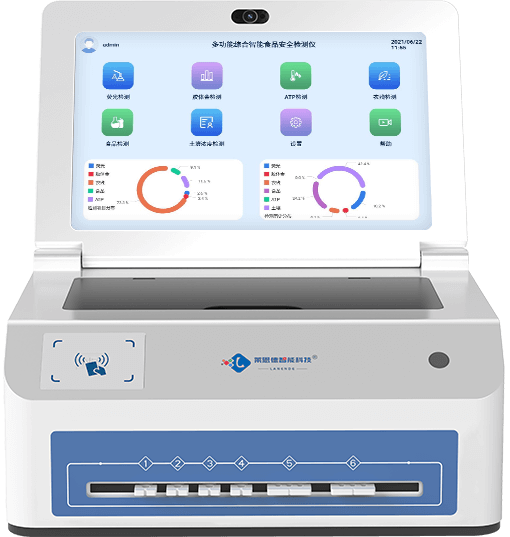
Gold Standard Reader for Veterinary Drug Residue Detection
- Product Number:LD-JY4N
- Product Difference:15.6-inch HD display, suitable for food/soil/water quality analysis, standard configuration includes fluorescence module
 +86 19353291814
 Online Consultation
Product Introduction
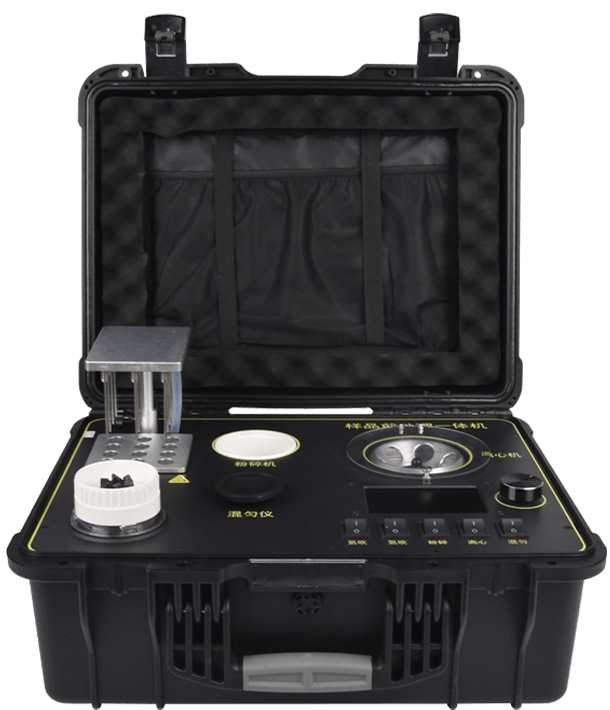
The Gold Standard Pesticide Residue Detector comprises detection, authentication, data processing, and wireless communication modules. It detects residues of veterinary drugs, antibiotics, pesticides, illegal additives, toxins, and heavy metals in most food products—including agricultural byproducts, aquatic products, and livestock/poultry products—and issues edible agricultural product compliance certificates. Featuring an Android system, smart integration with agricultural traceability platforms, and expandable multi-item testing capabilities, it delivers effective and accurate results.
The four standardized testing modules comprise:
- Multifunctional Module
- ATP Bacterial Quantification Module
- Colloidal Gold Module
- Fluorescent Quantitative Detection Module
1. Multifunctional Module
① Pesticide Residues: Detects organophosphorus and carbamate pesticides via enzyme inhibition rate method; controls pesticide residue reagent quality using limit-based enzyme inhibition rate method.
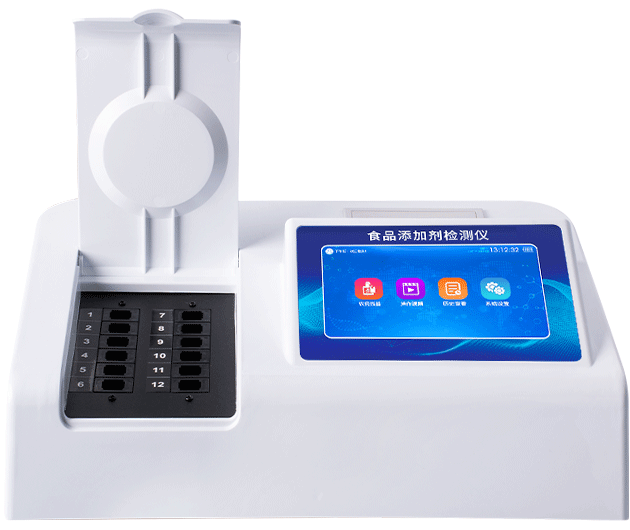
② Food additives: Sulfur dioxide, hydrogen peroxide, nitrites, nitrates, sodium benzoate, sorbic acid, sodium cyclamate, sucralose, acesulfame potassium, magnesium sulfate, etc.
③ Toxic Substances: Formaldehyde, sodium formaldehyde sulfoxylate, borax, benzoyl peroxide, caustic soda, potassium bromate, Rhodamine B, melamine, Sudan Red, etc.
④ Application of the Lambert-Beer Law.
2. ATP Bacterial Quantification Module: Capable of generating standard curves for all microbial communities, subsequently providing quantitative results (CFU/mL) based on the calibrated curve.
3. Colloidal Gold Module: Capable of detecting major categories including clenbuterol hormones, antibiotics, aquatic product safety contaminants, drug residues in eggs, and animal disease pathogens.
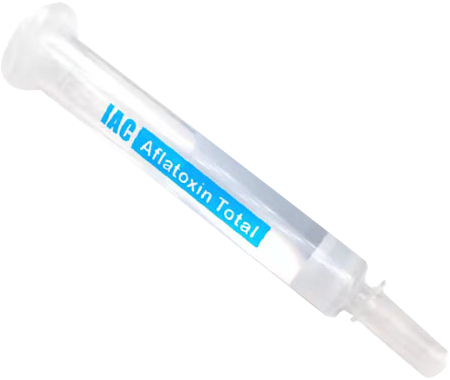
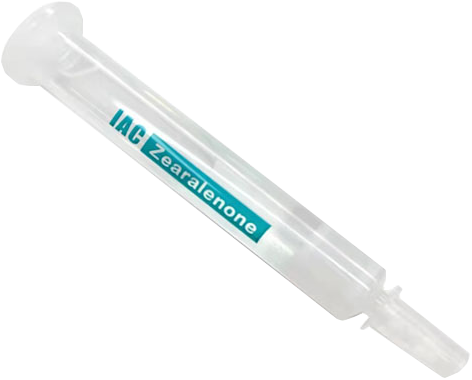
4. Fluorescent Quantitative Detection Module: Employing rapid fluorescent quantitative detection principles, this module primarily detects mycotoxins, heavy metals, pesticide residues, antibiotics, and other contaminants in food.
Product Features
Fluorescent Immunoassay: Utilizes fluorescently labeled reagents to detect target molecules, enabling quantitative analysis with sensitivity 10-100 times higher than traditional colloidal gold methods.
Colloidal Gold Immunoassay: A rapid detection technology based on antigen-antibody specific binding, offering simple operation and fast, stable qualitative/semi-quantitative testing.
ATP Bioluminescence Assay: A highly sensitive detection technology based on the firefly luciferase catalytic reaction, providing high sensitivity and rapid testing.
Integrated photometric colorimetry.
High sensitivity: Detects trace components, requiring only 1 μg/mL of target substance for accurate results.
Simple operation: Features a straightforward instrument design with low cost, suitable for rapid determination of routine physicochemical parameters.
Objective and accurate: Eliminates subjective errors through photoelectric conversion elements, yielding more stable and reliable measurement results.
Limited selectivity: Requires filters or separation of interfering substances to enhance selectivity, but cannot completely eliminate interference from coexisting ions.
Limited Applicability: Operates exclusively within the visible spectrum (300-700nm), incapable of covering ultraviolet or infrared regions.
Network Platform: Uploads device detection data to a network platform for centralized aggregation and backup, ensuring data security.
Unlock Methods: Facial recognition, fingerprint, password, ID card.
Integrated incubation and detection: Temperature range room temperature +5°C to 60°C (default 38°C).
Incubator: Constant-temperature incubation with automatic detection upon completion.
Card insertion detection: Testing cannot proceed without a card inserted into the detection channel.
Built-in Quality Control: Supports device submission for inspection, device self-check, and reagent card self-check.
Testing Methods: Incubation testing and rapid testing (for re-verification of test data).
Test Reports: Prints corresponding results based on different testing principles. Print layout can be adjusted in settings.
Automatically determines sample validity for more intuitive results.
Project Management: Supports project expansion.
Sample Management: Supports sample expansion.
Test Personnel: Allows adding and adjusting test personnel.
Test Information: Supports adding and adjusting test details (including re-test information).
Interface settings allow modification of headers and footer information for flexible display of instrument details.
Data processing: Supports data aggregation via communication ports and uploads to regulatory platforms.
The instrument features a versatile sample menu library, enabling flexible selection of test samples. Different detection channels can simultaneously analyze distinct sample parameters.
Utilizes an imported light source offering low power consumption, high precision, strong stability, and fast response speed.
Features intelligent constant-current voltage regulation and automatic light intensity calibration, ensuring no temperature drift during prolonged continuous operation.
Includes self-diagnostic functions: performs power-on self-test and zero calibration.
Product parameters
| Fluorescence Module | Detection Technology | Reflective Photoelectric Technology |
| Detection Principle | Fluorescent Immunoassay | |
| Detection Method | Standard Curve | |
| Accuracy | Error ≤5% | |
| Stability | CV (Coefficient of Variation) ≤5% | |
| Repeatability | CV (Coefficient of Variation) ≤3% | |
| Resolution | 0.001 | |
| Adapter Housing | 70mm*20mm*5.6mm | |
| Detection Channels | 4 single-card slots | |
| Detector/Light Source | Photodiode array, 365nm light source | |
| Detection Speed | Single test duration < 5 seconds, enables fluorescence quantification of samples | |
| Detection Method | Automatic scanning | |
| Colloidal Gold Module | Detection Technology | Reflective Photometric Technology |
| Detection Principle | Colloidal Gold Immunoassay | |
| Detection Method | Line Fading Method, Colorimetric Method | |
| Accuracy | Error ≤5% | |
| Stability | CV (Coefficient of Variation) ≤5% | |
| Repeatability | CV (Coefficient of Variation) ≤ 3% | |
| Resolution | 0.001 | |
| Card Dimensions | Single Card: 70mm × 20mm × 5.6mm; Triple Card: 70mm × 40mm × 5.6mm | |
| Test Channels | 4 single-card slots, 2 triple-card slots | |
| Testing Speed | Single test duration < 5 seconds; performs colloidal gold qualitative testing on samples | |
| Testing Method | Automatic scanning | |
| ATP Module | Detection Wavelength Range | 300nm–650nm |
| Detection Accuracy | 10⁻¹² to 10⁻¹⁶ mol | |
| Detection Range | 0-99999 RLUs | |
| Resolution | 1 RLU | |
| Repeatability | CV ≤ 3% | |
| Stability | CV ≤ 3% | |
| Power-on Self-Test | 30 seconds | |
| Test Duration | 15 seconds | |
| Detection Interference | ±5% or ±5RLUS | |
| Detection Mode | RLU | |
| Photoelectric Colorimetric Module | Detection Technology | Photoelectric Colorimetry |
| Detection Method | Absorbance, Enzyme Inhibition Rate, Standard Curve, Lambert-Beer Law | |
| Detection Modules | 2 sets (12 channels/set) | |
| Detection Channels | 24 detection channels enable simultaneous testing of multiple samples with continuous cycling—place and test immediately | |
| Wavelength Configuration | 412-415nm, 520-525nm, 585-587nm, 620-622nm | |
| Absorbance Detection Range | 0.000~3.000 | |
| Absorbance Resolution | 0.001 | |
| Concentration resolution | 0.0001 | |
| Inhibition rate measurement range | 0%~100% | |
| Suppression Rate Indication Error | ≤10% | |
| Suppression Rate Repeatability | ≤5% | |
| Transmittance Accuracy | ±1.5% | |
| Transmittance Repeatability | ≤0.5% | |
| Drift | ≤0.005 Abs/3 min | |
| Device Specifications | Screen Size | 15.6-inch HD display; resolution: 1920 × 1080 |
| Operating System | Android 11, 4GB RAM, 32GB storage, expandable | |
| Language | Chinese/English | |
| Storage Capacity | 100,000+ (expandable within device memory limits) | |
| Operator Capacity | 10 users (expandable within device memory limits) | |
| Test Subjects | 1000 individuals (additional subjects can be added within device memory capacity) | |
| Printer | Supports thermal printing and A4 printing. Automatically generates A4 standard reports embedded with traceability QR codes containing anti-counterfeiting information from the operating unit. Operators can add built-in electronic seals. One-click printing of A4 paper reports featuring anti-counterfeiting QR codes + electronic seals. | |
| Thermal Paper | 57*30mm | |
| Data Transmission | Wi-Fi, Bluetooth, USB, RF card reading, QR code recognition, 5G mobile communications (optional) | |
| Interfaces | 2 USB ports; 1 USB-B port; 1 LAN port; 1 HDMI port | |
| Power | ≤240W | |
| Power Input | AC 220V ±20V, 50Hz ±1Hz | |
| Operating Environment | Temperature 0~50℃; Humidity 0~90% | |
| Dimensions & Weight | 463*410*222mm, Approx. 32kg |
Model Differences
| Model | LD-JY4A | LD-JY4B | LD-JY4N |
| Food/Soil/Water Quality | Select one | All | |
| Fluorescence Quantification | None | Standard | |
| Screen Size | 10 | 15 | |
| ATP | Not available | Standard | |
| Constant-temperature heating | Not available | Standard | |
| Integrated Rotating Mixing | Not Available | Standard | |
| Face, Fingerprint, and ID Card Recognition | Not Available | Standard | |
| Rotary Colorimeter 24-Channel | Standard | ||
| Colloidal Gold Multi-Channel + Multi-Card | Standard | ||
| A4 Printing Function | Standard | ||
| Electronic Signature | Standard | ||
 Prev
Prev Next
Next